Why Evolution Needs Both Chance And Selection
Evolution does not begin with planning. It begins with change.
That change often starts at the level of DNA. A base is swapped. A segment is lost. A copy is made twice. These events are random mutations. They do not appear because an organism “needs” them. They appear because copying DNA is a physical process, and physical processes make errors.
This is where luck enters. A mutation may do nothing. It may cause harm. Or it may help. Most mutations do not create dramatic new traits. Many are neutral. Some are damaging. A few give an organism a better fit with its environment.
But luck alone does not drive evolution forward. A useful mutation still has to survive the filter of natural selection. It must help its carrier live long enough to reproduce, or help produce more surviving offspring. If it fails that test, it disappears no matter how interesting it looks in theory.
A simple image helps. Think of mutation as throwing new keys onto a table. Most keys fit no lock. Some fit poorly. A few fit well. Natural selection is the hand that tries the keys in real doors. Without new keys, nothing changes. Without the doors, the keys mean nothing.
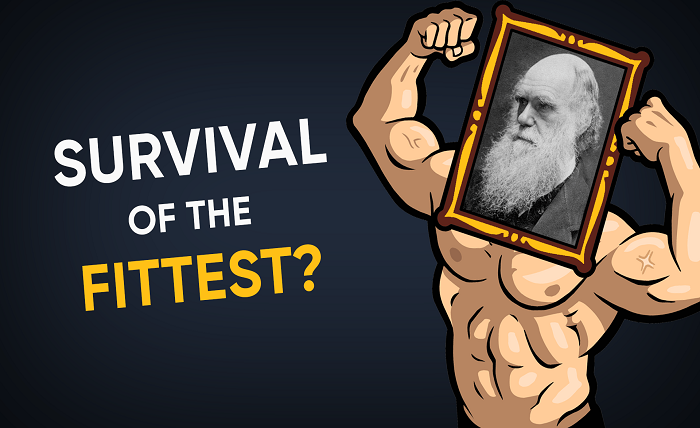
This is why the old phrase “survival of the fittest” can mislead if read too narrowly. Fitness does not mean strength alone. It means better match to the conditions at hand. And that match often begins with a lucky accident in DNA.
So the real answer is not fittest or luckiest. Evolution needs both. Chance creates variation. Selection sorts it. One supplies the raw material. The other decides what stays.
How Random Mutations Arise At The DNA Level
Mutations begin during DNA copying.
Each time a cell divides, it must copy billions of base pairs. The process is fast and precise, but not perfect. Enzymes read one strand and build another. Sometimes they insert the wrong base. Sometimes they skip one. Sometimes they add an extra piece.
These small slips create point mutations. A single letter changes. That change can alter a protein, or it can do nothing at all. The effect depends on where it occurs and how it shifts the code.
Other mutations come from external factors. Ultraviolet light can damage DNA. Chemicals can break bonds or distort structure. When the cell repairs this damage, it may restore the sequence incorrectly. The repair itself becomes the source of change.
There are also larger events. Segments of DNA can be duplicated, deleted, or moved. These changes can affect many genes at once. They are rarer, but they carry stronger effects.
The key point is randomness. The cell does not choose where to change. It does not aim for improvement. It follows physical rules. Errors arise from speed, exposure, and repair.
This randomness is similar to how outcomes appear in systems driven by repeated trials. Each event stands on its own. There is no memory guiding the next result. In a different context, a user on a desi casino site sees outcomes generated without intent or preference. The system produces results through fixed rules, not goals. Mutation follows a comparable logic. It produces variation without direction.
Most mutations pass unnoticed. Some disrupt function. A few create new traits. The system does not plan for success. It generates options.
Evolution then decides which of those options persist.
From Mutation To Advantage: When Change Becomes Useful
A mutation matters only if it changes function and affects survival or reproduction.
Most changes stay silent. They occur in regions that do not alter proteins. Or they swap one base for another that codes for the same amino acid. The organism continues without difference.
Some changes harm function. A protein folds the wrong way. A pathway slows. These mutations reduce fitness. They tend to disappear because carriers leave fewer offspring.
A small set creates advantage. The change improves how a protein works or when it is used. It may help an organism process food better, resist a pathogen, or tolerate heat. The benefit does not need to be large. Even a slight edge can matter over many generations.
Context decides value. A mutation that helps in one environment may harm in another. A thicker coat helps in cold climates but becomes a burden in heat. The same genetic change can switch roles as conditions shift.
Once a useful mutation appears, selection amplifies it. Carriers survive at higher rates or produce more offspring. The mutation spreads through the population. Over time, it can become common.
This spread is not instant. It depends on population size, reproduction rate, and environmental pressure. Strong pressure speeds the process. Weak pressure slows it.
The key idea is simple. Mutation creates a change. The environment tests it. If it helps, it grows. If it does not, it fades.
Advantage is not built in. It is revealed through use.
Genetic Drift: When Luck Shapes Outcomes Without Advantage
Not all changes spread because they help. Some spread because of chance alone.
This process is called genetic drift. It becomes strong in small populations. When few individuals reproduce, random differences in who survives can shift gene frequencies quickly.
Imagine a small group after a storm. By chance, a few individuals carry a certain gene. Others do not. The next generation reflects that accident, not a clear advantage. Over time, the gene may become common or disappear, even if it has no effect on fitness.
A classic case is the founder effect. A small group leaves a larger population and starts a new one. The genes in that group set the starting point. Some variants become frequent simply because they were present at the start.
Another case is the bottleneck. A population shrinks sharply due to disease or disaster. The survivors carry only a subset of the original variation. Future generations inherit that limited set, again shaped by chance.
Drift can work alongside selection. A useful mutation may spread faster. A neutral one may spread slowly or fluctuate. A harmful one may still rise for a time if chance favors it, though selection often removes it later.
The key point is balance. Evolution is not a straight line of improvement. It is a mix of selection and randomness. Drift shows how outcomes can shift without clear advantage.
Luck does not replace selection. It operates beside it, especially when numbers are small.
Evolution Is A Balance Of Chance And Filter
Evolution works through a simple loop. Variation appears. Conditions test it. Results accumulate.
Random mutations create the variation. They do not aim for improvement. They generate options. Most options do nothing. Some harm. A few help.
Natural selection acts as the filter. It keeps changes that improve fit with the environment. It removes many that do not. This process repeats across generations.
Genetic drift adds another layer. It shows how outcomes can shift through chance, especially in small groups. Not every change needs an advantage to spread, at least for a time.
The full picture is not “luck or fitness.” It is luck feeding into selection. Chance supplies the raw changes. The environment decides which changes last.
This balance explains both stability and change. Species remain consistent where conditions hold. They shift when new pressures appear or new variations arise.
In the end, evolution is not guided by intent. It is shaped by random input and consistent filtering.