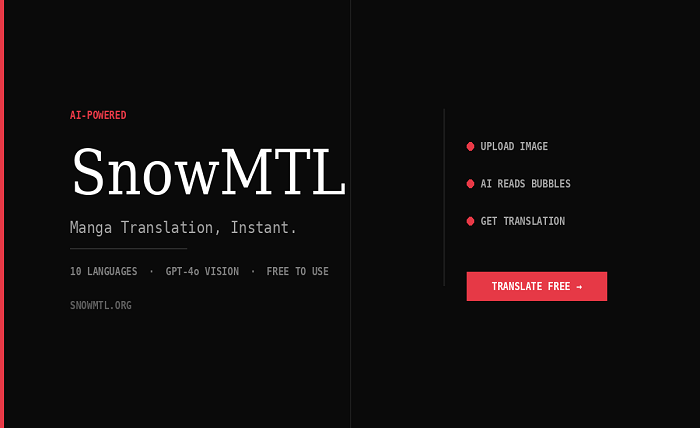
SnowMTL emerged as a significant player in the online manga reading community, offering something that traditional scanlation groups and official publishers couldn’t match: speed. At its core, SnowMTL was a machine translation platform that used automated tools to translate Asian comics—including manga, manhwa, and manhua—into English and other languages . Unlike human translators who might take days or weeks to localize a single chapter, SnowMTL could produce readable versions almost immediately after the original release.
For many readers worldwide, SnowMTL became more than just a website—it was a daily habit and a gateway into global comics culture . The platform’s appeal was straightforward: it offered free access to a vast library of content, updated rapidly, and required nothing more than an internet connection. This accessibility made SnowMTL particularly attractive to readers who couldn’t afford subscription services or who lived in regions where official translations were slow to arrive.
The name “SnowMTL” itself hints at its function—”MTL” standing for Machine Translation. This technology extracts text from comic images, processes it through AI-powered translation engines, and places the translated text back into the panels . While this method sacrifices nuance and cultural context, it delivers functional translations that allow readers to follow storylines without waiting.
How SnowMTL Worked: The Technology Behind the Platform
Understanding SnowMTL requires a look at its technical underpinnings. The platform relied on automated translation systems that bypassed traditional human translation workflows entirely . Instead of scanlation teams—which involve cleaners, typesetters, translators, and proofreaders—SnowMTL used algorithms to handle everything.
The process typically began with the platform scraping new chapter releases from original sources. Optical Character Recognition (OCR) technology would extract text from the comic panels, then machine translation engines (like Google Translate or Bing Translate) would convert the text into the target language . The translated text was then overlaid onto the original images, creating a complete chapter ready for reading.
This automated approach had distinct advantages. SnowMTL could publish multiple chapters simultaneously, covering series that smaller scanlation groups might ignore. The platform’s library grew rapidly, attracting readers who wanted variety or who followed niche titles . However, the technology also had clear limitations. Machine translation often produces awkward phrasing, loses emotional nuance, and occasionally creates sentences that are grammatically correct but contextually wrong .
For readers accustomed to professional localization, SnowMTL’s output could be jarring. Yet for many users, especially those reading for plot progression rather than literary appreciation, the trade-off was acceptable. SnowMTL provided “good enough” translations that allowed them to stay current with ongoing series .
The Rise of SnowMTL: Why Readers Flocked to the Platform
SnowMTL’s popularity wasn’t accidental—it filled a genuine gap in the manga reading ecosystem. Official translations from publishers like VIZ Media or Kodansha typically lag behind Japanese releases by weeks or months. For fans invested in ongoing series, this wait can feel interminable . SnowMTL offered a solution: near-instant access to translated chapters, often within hours of the original release.
The platform’s free access model was another major draw. While official services require subscriptions or per-chapter payments, SnowMTL was completely free to use . This made it especially popular among younger readers or those in countries where official manga services aren’t available or affordable.
SnowMTL also benefited from the growing global interest in Korean manhwa and Chinese manhua, which historically had even fewer official translation options than Japanese manga . The platform covered titles that were otherwise inaccessible to international audiences, creating a reader base that appreciated the service despite its imperfections.
Community discussions often highlighted SnowMTL’s value for keeping up with multiple series simultaneously. One reader noted that “SnowMTL became a daily habit” because it provided a one-stop shop for various titles . The simple interface and straightforward navigation made it easy for newcomers to find and read content without technical hurdles.
The SnowMTL Shutdown: What Happened to the Platform?
When SnowMTL suddenly stopped loading, readers were left confused and frustrated . The platform became inaccessible without any public announcement or explanation, creating a vacuum of information that sparked widespread speculation across online communities . This mysterious shutdown followed a pattern common to unofficial platforms—developers often choose silence over transparency when facing challenges.
Several factors likely contributed to SnowMTL’s closure. Legal and copyright issues are the most plausible explanation . By distributing content without proper licensing, SnowMTL operated in a legal grey area that put it at risk of takedown notices or legal action from publishers. Many similar platforms have faced shutdowns under copyright pressure, and SnowMTL may have simply been the next in line.
Cost is another significant factor. Running servers capable of handling global traffic, maintaining machine translation systems, and managing data storage requires ongoing financial investment . Without a revenue stream—SnowMTL was free to users—these costs may have become unsustainable for the developers.
Some community speculation suggested that the developers may have abandoned the project for personal reasons or moved on to other ventures . Competition from improved official services and other unofficial platforms may also have reduced SnowMTL’s relevance over time. Regardless of the exact reasons, the result was the same: SnowMTL was gone, leaving readers to search for alternatives.
Safety and Legality: The Risks of Using SnowMTL
While SnowMTL offered convenience, using the platform came with inherent risks that readers should understand. From a security perspective, the site raised red flags. According to website verification tools, SnowMTL lacked a valid SSL certificate, which is considered a minimum requirement for modern web safety . An SSL certificate encrypts data between the user’s browser and the website—without it, sensitive information is vulnerable to interception.
The platform’s ownership was also unclear, with domain information suggesting it was registered for nearly two years but without transparent company details . This lack of transparency is common among unofficial platforms, but it makes it difficult for users to assess trustworthiness or accountability. Some security tools flagged SnowMTL due to these hidden ownership details and mixed safety signals .
Legally, SnowMTL existed in a problematic space. The platform distributed content without owning the rights or obtaining proper licensing . This means that by using SnowMTL, readers were technically engaging with copyrighted material in an unauthorized manner. While individual readers rarely face legal consequences for simply viewing content, the platforms themselves are legitimate targets for publishers seeking to protect their intellectual property.
The ethical dimension is equally important. Machine translation platforms like SnowMTL provide value to readers but don’t compensate creators . Artists and authors rely on official sales and licensed translations for their livelihoods. By choosing unofficial platforms, readers indirectly undermine the industry that produces the content they enjoy.
Alternatives to SnowMTL: Where to Read Manga Legally
Following SnowMTL’s shutdown, readers have several alternatives for accessing translated manga, each with different trade-offs between cost, quality, and availability.
Official subscription services offer the safest and highest-quality option. Platforms like VIZ Media’s Shonen Jump, Manga Plus, and ComiXology provide professionally translated chapters, often simultaneously with Japanese releases . These services typically cost a few dollars per month and offer extensive libraries. The translation quality is excellent, and the reading experience is optimized for digital devices. The trade-off is cost and regional availability—not all services are accessible worldwide.
Webtoon and Tapas are excellent alternatives for readers focused on Korean manhwa and webcomics. These platforms offer both free and premium content, with official translations that maintain the original’s artistic and narrative quality . Many titles update on a regular schedule, and readers can earn free chapters through various engagement activities.
Aggregator websites that operate similarly to SnowMTL continue to exist, but they carry the same legal and security risks. These sites may be unstable, may contain malware, and could shut down without notice. While they offer free access, the cost to the industry and the risks to users make them a problematic choice.
Fan translation groups remain active for series without official releases. While slower than machine translation platforms, these groups often produce higher-quality translations that better preserve cultural nuances and emotional context. However, like SnowMTL, they operate in a legal grey area and may face takedown requests.
The Legacy of SnowMTL: What We Learned
SnowMTL’s story reflects broader trends in digital media consumption and the tension between accessibility and sustainability. The platform demonstrated that there is massive global demand for translated comics, and that traditional distribution channels weren’t meeting that demand quickly enough . Official publishers have begun responding—with more simultaneous releases, expanded regional availability, and competitive pricing—but SnowMTL’s popularity suggests there’s still work to be done.
The platform also highlighted the potential and limitations of machine translation technology. AI-powered translation has advanced dramatically, and tools like SnowMTL showed that machine translation can make content accessible to global audiences at scale . However, the quality gap between machine and human translation remains significant, particularly for narrative fiction where tone, subtext, and cultural context matter deeply.
For readers, SnowMTL’s shutdown was a reminder of the fragility of unofficial platforms. When readers rely on free, unlicensed services, they accept the risk that those services could disappear at any time. This instability is the hidden cost of “free” content—you save money, but you lose reliability and quality assurance.
The ethical debate prompted by SnowMTL isn’t going away. The platform was simultaneously a valuable service for underserved readers and a threat to creators’ livelihoods . This paradox—that the same action can be both helpful and harmful—is central to understanding the ecosystem of unofficial translation.
Conclusion
SnowMTL represented a pivotal moment in the evolution of manga and manhwa consumption worldwide. By leveraging machine translation technology, it provided unprecedented access to Asian comics for global readers, building a loyal following through speed, variety, and free access . Yet its very strengths—automated translation and unauthorized distribution—were also its weaknesses, leading to quality compromises, legal risks, and eventual shutdown.
The platform’s legacy extends beyond its brief existence. SnowMTL demonstrated the massive gap between supply and demand in the official translation ecosystem, pushing publishers to improve their offerings . It showed that machine translation, while imperfect, can make content accessible at scale, pointing toward a future where AI plays a larger role in localization. And it reminded us that free platforms come with hidden costs—to creators, to reading quality, and to the stability of our access to content.
For readers today, the best path forward is to support official services where possible, while acknowledging that economic and regional barriers remain real challenges. The comics industry is evolving, and the pressure SnowMTL helped create is accelerating that evolution. As official services improve and expand, the need for platforms like SnowMTL may diminish—which would be good news for creators, publishers, and readers alike.
FAQs
Why did SnowMTL shut down?
SnowMTL likely shut down due to a combination of legal and copyright pressure, high operational costs, and possible abandonment by developers. No official statement confirmed the exact reason, but these factors are common among unofficial translation platforms that operate without proper licensing .
Is SnowMTL coming back?
There is no reliable information suggesting SnowMTL will return. The platform has been inactive, and most signs indicate permanent discontinuation. Any copycat sites claiming to be SnowMTL should be treated with caution .
Is SnowMTL safe to use?
When it was operational, SnowMTL lacked valid SSL certificates and had unclear ownership, which raised security concerns. Using the platform also involved accessing potentially copyrighted material without authorization. Official platforms with proper security and licensing are significantly safer options .
What alternatives exist to SnowMTL?
Official subscription services like VIZ Media’s Shonen Jump, Manga Plus, Webtoon, and Tapas offer legal, high-quality alternatives. These platforms provide professionally translated content and a stable reading experience, though they may require payment or have regional restrictions .
What does SnowMTL stand for?
SnowMTL stands for “Snow Machine Translation.” The name reflects the platform’s core technology—using automated machine translation tools to convert manga text from original languages into English and other languages .